Rights for me but not for thee
The ICCL is helping to intimidate the rest of society into being afraid to challenge a privileged self-appointed caste to have their own way irrespective of the rights of others, especially those of women and children.


Almost five years ago Niamh Smyth TD asked the then Minister for Social Protection Heather Humphreys TD about the legal meaning of the 2015 Gender Recognition Act.
She asked if the Gender Recognition Act "means that a man who self-identifies as a woman is entitled to access any and all female-only spaces and services; and if she will make a statement on the matter."
She also asked the Minister if the Gender Recognition Act "means that a man is entitled to have their transgender belief that they identify as a woman outweigh the right of a woman or girl to object to their presence in a female only space and if she will make a statement on the matter."
Deputy Smyth also asked if the Act "means that a man who self-identifies as a woman is perceived by this legislation to be safe to access female only spaces irrespective of the physiological differences between male and female bodies; and if she will make a statement on the matter." Minister Humphreys responded:
"These questions seek an interpretation of the law. The Deputy will appreciate that, as Minister, I am not in a position to offer any such interpretation, as such matters are reserved for the courts."
This was five years after the Gender Recognition Act 2015 had been passed yet the Minister whose department is responsible for issuing Gender Recognition Certificates couldn't answer the question.
So how are ordinary citizens to know what the law does or doesn't mean?
Five years on from Niamh Smyth's questions Women's Space Ireland put a similar question to the Irish Human Rights and Equality Commission (IHREC):
"Under Irish legislation such as the Equal Status Act 2000 which allows for exemptions from treating both sexes equally when it comes to situations involving the need for privacy, does a man who purports to be a woman and has a Gender Recognition Certificate have the right to use women's facilities in the workplace irrespective of the wishes of women who want single-sex provision in workplace changing rooms and toilets?"
IHREC responded:
"As your email concerns your rights, we would encourage you to visit our Your Rights Information Service at https://www.ihrec.ie/your-rights/. The service provides information on equality and human rights law in Ireland. It is mobile friendly, available in multiple languages, fully accessible, and updated regularly.
Please note that IHREC’s online Your Rights Information Service is the only way that we provide information on equality and human rights law in Ireland. We do not provide tailored information or analysis on individual circumstances or cases."
That hasn't stopped IHREC and other NGOs (non-governmental organisations, most of which are funded by the Government) from pronouncing on the rights of those who call themselves transgender and non-binary.
One NGO which isn't largely funded by the Government is the Irish Council for Civil Liberties (ICCL). The ICCL's income of €1,483,426 to end 2024 came from a variety of sources including the Open Society Foundations, Rowan Trust, Luminate Group, Sigrid Rausing Trust with €4,600 from the IHREC, which is funded by the Government. The Government's estimate for the funding of IHREC to end December 2025 is €9,709,000.
Earlier this month the ICCL, which uses as its tagline "For All Our Rights, No Exceptions", published Know Your Rights, A Guide for Trans and Non-Binary People along with TENI, the Transgender Equality Network Ireland and ShoutOut:
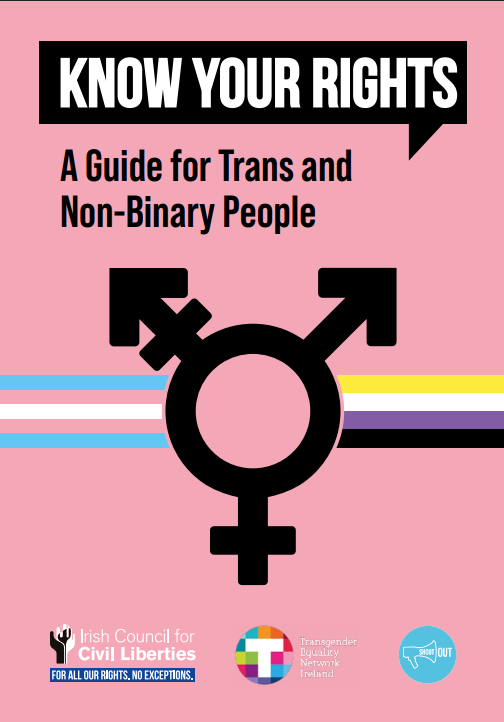
"Developed with the support of legal experts, it was created through consultations with members of the trans and non binary community through focus groups, surveys and reviews." reported RTE.
"The 'Know Your Rights' guide was funded by IHREC as part of the Irish Human Rights and Equality Grants Scheme. Legal advice was provided pro bono by lawyers at the FLAC LGBTQI+ Legal Advice Clinic and A&L Goodbody."
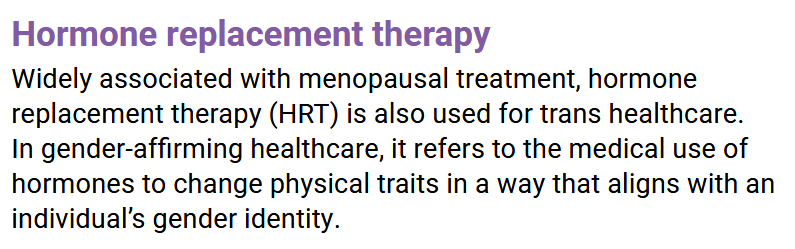
The guide is heavy on assertions but light on citing references to back these up. For example, men who "identify" as women aren't suffering from declining estrogen levels as is the case for menopausal women, so why is it called "hormone replacement therapy"?
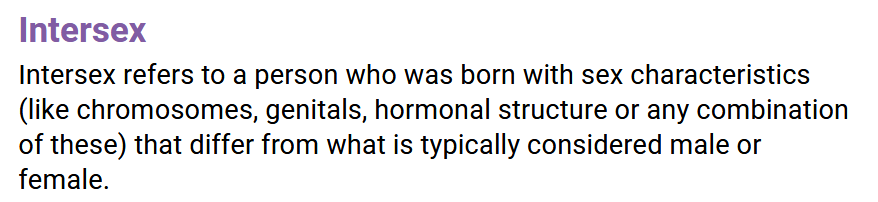
This use of the word "intersex" is typical of activist speak given that it's an outdated term for some 40+ Differences in Sex Development (DSD) which affect a tiny proportion of men and women. For instance, Klinefelter Syndrome only affects men; MRKH only affects women. Each DSD is therefore distinguished by which sex is affected. Activists have appropriated these conditions for years in order to pretend that sex is on a spectrum when it is in fact simply binary.
Safeguarding issues
Failing to disclose that an individual is masquerading as the opposite sex may be a serious safeguarding issue for organisations which need to be sure that men are not employed or allowed volunteer in roles which might involve e.g. working with women who would not consent to having men provide intimate care or with children in a setting which is not appropriate:
"For example, under the National Vetting Bureau (Children and Vulnerable Persons) Act 2012, a person wishing to be vetted must provide any former name they might have had. The National Vetting Bureau has a responsibility to process this data sensitively, and without disclosing yours trans status to your employer or vetting organisation." (page 68 of the guide)
The guide says that although there is "no specific provision in Irish law concerning the use of bathrooms [note use of an American term] or changing rooms" according to an individual's gender identity, in general "you should be able to use" the facilities you want in venues like restaurants, gyms and shops, including clothing shops.
"If you are denied access to bathrooms or changing rooms that correspond to your gender identity, this could constitute a refusal of goods or services on the basis of your gender and may amount to discrimination under the Equal Status Acts 2000-2018." (page 90 of the guide.)
There's no mention of the rights of women to privacy and dignity which the Equal Status Act 2000 provides for in exemptions allowed from having to treat both sexes equally. Section 5 (2) (g) of the Act states that it's not discrimination to have
"differences in the treatment of persons on the gender ground where embarrassment or infringement of privacy can reasonably be expected to result from the presence of a person of another gender,"
The ICCL guide also claims that
"Likewise, a cosmetic service provider would be discriminating on the gender ground of the Equal Status Acts 2000-2018 if it denied trans women access to a service for women." (page 90 of the guide.)
Would the ICCL advise a man that he's legally entitled to have his genitalia waxed in a women's salon? Would they tell women who work in such a salon that they would be discriminating on the gender ground if they refuse to wax the man's genitalia? What advice would the ICCL offer women who are salon customers who want to have their rights upheld as the Equal Status Act clearly provides for in the exemptions allowed under the "gender ground" such as allowing
(c) differences in the treatment of persons on the gender ground in relation to services of an aesthetic, cosmetic or similar nature, where the services require physical contact between the service provider and the recipient," (Section 5 (2) (c) of the Equal Status Act.)
What's more, the "gender ground" in the Act is clearly defined on the basis of one's sex:
"(2) As between any two persons, the discriminatory grounds (and the descriptions of those grounds for the purposes of this Act) are
(a) that one is male and the other is female (the 'gender ground')," (Section 3 (2) (a) of the Act.)
Such one sided advice places businesses, companies and other organisations in a very difficult position as they will naturally fear being sued for discrimination.
On children in schools
There's no mention in the ICCL guide of parents' Constitutional rights in relation to their own children which is a curious omission. Affording agency to a child and a school is surely at odds with the rightful role of parents in the care and knowledge of what is happening in relation to their own child.
Article 42 of the Constitution
"1 The State acknowledges that the primary and natural educator of the child is the Family and guarantees to respect the inalienable right and duty of parents to provide, according to their means, for the religious and moral, intellectual, physical and social education of their children."
Questions children might have include:
"Do I have a right to use bathrooms and changing facilities that match my gender identity?
There is no specific provision in Irish law concerning the use of
bathrooms and changing rooms according to a person’s gender
identity. However, as a trans student you should be able to access
toilets and changing facilities that correspond with your gender
identity.
If you are told you are not allowed to use a bathroom matching your
gender identity, this may constitute discrimination on the basis of
gender."
"Do I have a right to share rooms with students of the same gender as me on school trips?
There is no official guidance on sharing rooms with other students on
school trips. However, your school may have its own policy covering
school trips and tours. This may include parental or guardian consent
forms and the allocation of shared sleeping arrangements.
Your parent(s) or guardian(s) will be asked to consent to any overnight
tour you go on and they should speak directly with the relevant teacher
about your sleeping arrangements. Your school should support you to
stay where you feel most comfortable and safe — with students of the
same gender as yourself, or otherwise, depending on your needs."
(page 121)
The rights and privacy needs or preferences of other students aren't mentioned as something to be considered. Does the ICCL believe the parents of other children should be asked for their consent to have a child of the opposite sex use the toilets or sleep in the same room as their child?
Names and pronouns for children in school
The guide also uses the word "must" which suggests a legal requirement for which there may be consequences for non-compliance.
"Do I have a right to have my correct name and pronoun used in school?
According to Department of Education guidelines, your school must
make every effort to update your name and pronoun in relevant
systems and documents. It must also use your correct name and
pronoun in day-to-day interactions. You should clarify with the
school what your preferences are for name and pronoun usage in
written communications to your parent(s) or guardian(s)." (page 125)
Asked under which guidelines this is required and if this is mandated under any legislation the ICCL responded that
"The relevant guidelines and legislation are the GLEN & DES Being LGBT In School resource (pages 18 and 20), GDPR (accurate data), and Equal Status Act (harassment and prevention of harassment)."
Being LGBT in School was produced by GLEN (the Gay and Lesbian Equality Network, the Department of Education and Skills and various education partners. GLEN was wound down in 2017 following a review of its operations. Financial irregularities had been apparent the previous year. (Right click and open new tab if these hyperlinks don't immediately work.)
On page 18 of the GLEN/DES guide it's not clear where the assertion originates that a child's school "must also use your correct name and pronoun in day-to-day interactions" as claimed in the ICCL guide. The GLEN/DES guide says
"Using the correct name, pronoun and gender is a mark of respect against which individuals will measure the level of safety and inclusion for them within the school."
It's not clear either where on page 20 of the GLEN/DES guide that a school must make every effort to update a child's name and pronoun in relevant systems and documents.
So why is the word "must" used by the ICCL? A small caveat in very tiny font is appended to the bottom of each page of the guide which may explain:
"Important: this guide is for your information only. It is not intended to be a substitute for legal advice."
The Department of Education was asked the same question as posed to the ICCL and didn't answer the question but instead talked generally about the "Bí Cineálta anti-bullying procedures" which are being implemented from the beginning of the current school year, 2025/2026. The Department went on to say
"In 2016, the department published a resource for post-primary schools –Being LGBT in School in order to provide assistance for schools in designing their policies. It provides guidance to support key individuals as they fulfil their responsibilities in ensuring that their school is safe, supportive and affirming of all students, including lesbian, gay, bisexual and transgender students, students perceived to be LGBTIQ+ and students who have close family members (parents, siblings, etc.) who are LGBTIQ+. It offers guidance around the use of pronouns in the post-primary school setting.
This resource is currently under independent review by Maynooth University, and it is intended that an updated resource, in line with best practice, will be issued to schools once the review is complete."
"The contract was awarded to Maynooth University following a competitive tendering process and is being conducted by members of the Department of Education, Maynooth University. The research is jointly funded by the Department of Children, Disability and Equality and the Department of Education and Youth."
Are guidelines that are described as being ‘in line with best practice’, guidelines that schools ‘must’ follow?
Credits for the ICCL guide
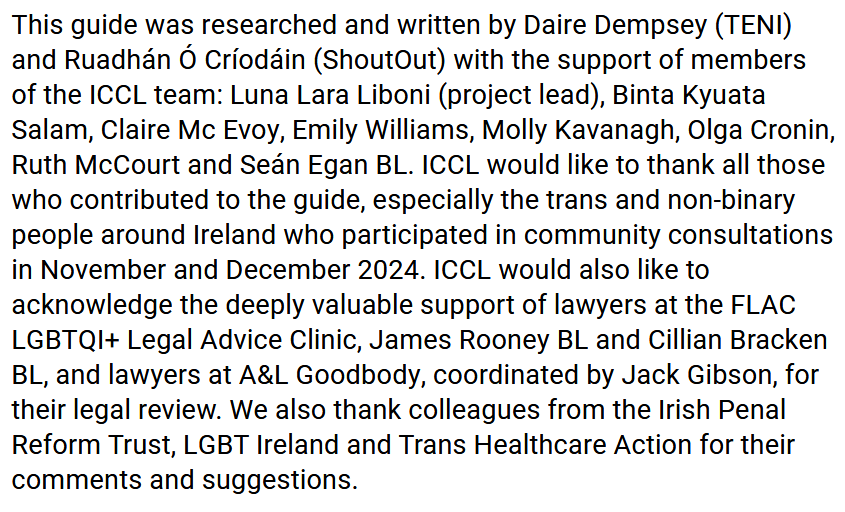
A&L Goodbody, the large corporate legal firm with offices now as far afield as New York and San Francisco says it has provided over 69,000 pro bono hours since 2013. Some of those fortunate enough to be provided with such legal expertise last year were LGBT Ireland which is largely Government funded and BeLonG To Youth Services which also receives a large proportion of its funding from Government.
Women in Ireland are very concerned at the impact on our rights by the promotion of gender identity through legislation and in Irish society generally. We don't receive any of the funding granted to a large number of NGOs, such as the National Women's Council of Ireland which believes that "By ‘woman’ we refer to any person who identifies as a woman." Women also need to know what our rights are given the impact of the Gender Recognition Act on women and children with men in women's prisons, women's toilets, our sports and with this ideology being promoted to children in our schools.
In passing the Gender Recognition Act at the behest of activists, an 84% male Dáil in 2015 put women in the position of having to go to court to vindicate our rights which they as legislators so casually handed to men.
The ICCL's claim that it acts "For all our rights, no exceptions" clearly omits those of women and children. In continuing this lobby's use of lawfare to elevate the so-called "rights" of men and women who call themselves "trans" the ICCL is helping to intimidate the rest of society into being afraid to challenge a privileged self-appointed caste to have their own way irrespective of the rights of others, especially those of women and children.